

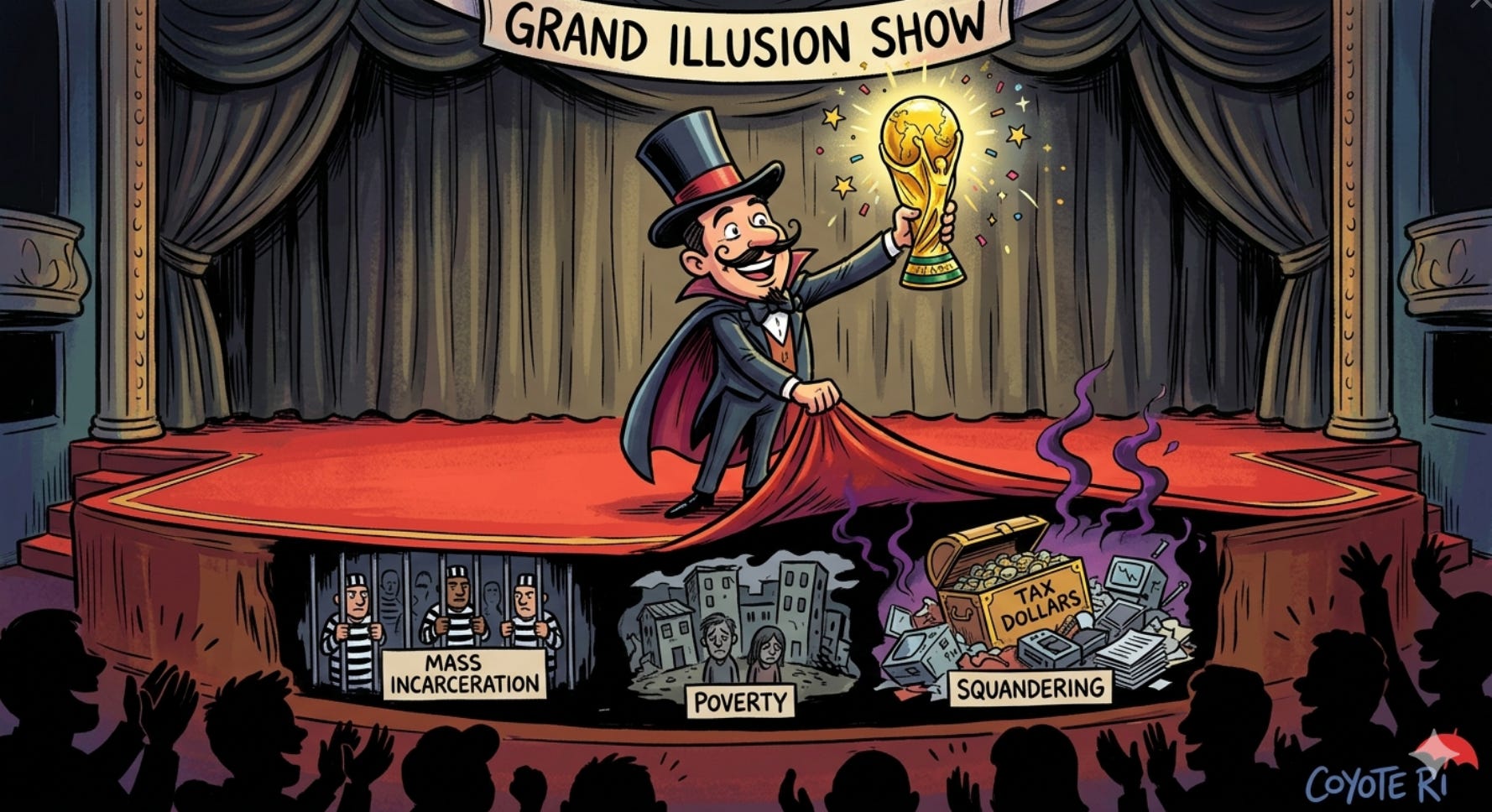
Imagine, um, you’re sitting in this massive, just really ornate theater. And you are watching a
master illusionist up on stage. Okay, I can picture it.
So the spotlight is blinding. It’s focused entirely on the magician’s right hand. And they’re waving this shiny gold coin around, doing all these, you know, flashy flourishes.
Right, drawing all the attention. Exactly. You literally can’t take your eyes off it.
But the real trick, like the actual mechanics of the illusion that is happening entirely in the dark in their left hand, completely out of sight. Yeah, I mean, the classic art of misdirection, right? It reliesentirely on controlling your attention. The audience, while they only see what the performer actively illuminates.
And today, we are taking a deep dive into a topic where that exact kind of misdirection appears to be, well, the rule of law. We’re deconstructing the mainstream narrative around the sex trafficking
industry. Right.
And specifically, the multi-million dollar concept of the quote unquote rescue. Right. Because the sources we are analyzing today, they present a radically different picture from what you typically see on the evening news.
It’s pretty eye opening. It really is. So to give you some context on our sources today, we are examining two extremely comprehensive documents detailing the findings of Coyote RI.
And just to clarify, Coyote stands for call off your old tired ethics. Right. Exactly.
It’s a Rhode Island based advocacy and research organization, and it’s led heavily by current and former sex workers. So this isn’t just, you know, a brief surface level poll. Oh, definitely not.
No, this is the culmination of 15 years of exhaustive research. It is built on a highly specific 145 question diagnostic tool. Which is wild.
Gathering that level of detail from over 1500 individuals involved in underground economies. That is an incredibly heavy lift. It really is.
Yeah. Most traditional academic or, you know, state researchers, they just can’t get heavily policed populations to talk on the record. Right. Out of sheer self preservation. Why would you talk to the state? Exactly. But by utilizing peer led outreach, so researchers who actually understand the lived reality of these individuals, Coyote managed to build this massive data set.
And they paired those really granular responses about economics and policing with specific policy and financial data coming directly out of Rhode Island. So our mission today is to look past the clickbait, right? To look at the hard data about state funding, poverty, and frankly, who actually profits from these trafficking arrests. Right. And, you know, before we really get into it, because this deep dive touches on some highly charged systemic political issues, we need to establish something upfront. Yeah, that’s a good point. Our goal here isn’t to endorse a specific political side, not at all. We’re simply here to impartially map out the exact arguments and the specific data presented by these researchers.
We just want to lay out the mechanics of this challenging perspective so you can understand the findings, regardless of your personal stance. Exactly. Just sticking to the source material. So, okay, let’s unpack this. The researchers start exactly where the public’s understanding usually begins, which is with the high profile headlines. Right.
The stuff everyone sees on TV. Yeah. They point to a specific Rhode Island state police sting operation from June 23rd, 2026. And this was ostensibly tied to the World Cup. Oh, right. The big mega events. Yeah, the other ones. You see these massive press conferences, all the seized assets piled up on the table, the really dramatic announcements. But the source material describes these stings as a literal magic trick.
A magic trick, yeah. They call it curated fiction designed for social entertainment. Because according to the data, it frequently results in victimless arrests of consensual adults rather than actual traffickers. So, going back to your illusionist analogy, the state is waving the World Cup sting around as the shiny object, just to keep society from looking at the financial mechanics operating offstage. Exactly.
And they paired those really granular responses about economics and policing with specific policy and financial data coming directly out of Rhode Island. So our mission today is to look past the clickbait, right?
To look at the hard data about state funding, poverty, and frankly, who actually profits from these trafficking arrests. Right. And, you know, before we really get into it, because this deep dive touches on some highly charged systemic political issues, we need to establish something upfront.
\Yeah, that’s a good point. Our goal here isn’t to endorse a specific political side, not at all.
We’re simply here to impartially map out the exact arguments and the specific data presented by these researchers. We just want to lay out the mechanics of this challenging perspective so you can understand the findings, regardless of your personal stance. Exactly.
Just sticking to the source material. So, okay, let’s unpack this. The researchers start exactly where the public’s understanding usually begins, which is with the high profile headlines. Right. The stuff everyone sees on TV. Yeah.
They point to a specific Rhode Island state police sting operation from June 23rd, 2026. And this was ostensibly tied to the World Cup. Oh, right.
The big mega events. Yeah, the other ones. You see these massive press conferences, all the seized assets piled up on the table, the really dramatic announcements. But the source material describes these stings as a literal magic trick. A magic trick, yeah. They call it curated fiction designed for social entertainment.
Because according to the data, it frequently results in victimless arrests of consensual adults rather than actual traffickers. So, going back to your illusionist analogy, the state is waving the World Cup sting around as the shiny object, just to keep society from looking at the financial mechanics operating offstage. Exactly.
So, what are those mechanics? Like, why perform the illusion in the first place? Well, the research breaks down the exact mechanism behind it, and they refer to it as the monetization of myth. The monetization of myth. I like that phrase.
It’s powerful. The sources actually cite data from a report titled, What’s the Cost of a Rumor? Which is fascinating. It exposes how claims of these massive trafficking surges during major sporting events are, well, they’re essentially fabrications.
Wait, really? The surges aren’t real. The data simply does not support the hysteria. But the panic itself serves as a highly effective predatory policy tool.
Local police departments leverage this manufactured public panic to apply for and secure massive federal and state budget increases. Ah, so the mechanism is essentially a physical feedback loop. Precisely. Law enforcement creates a narrative of an impending crisis around an event ike the World Cup. Right. And that justifies buying high-tech surveillance equipment or authorizing just endless overtime. Exactly.
And it operates under this totally unassailable guise of public safety. But the result is a system that prioritizes police funding over the actual material needs of the marginalized people they claim they’re trying to rescue. Wow.
So if the mega event stings or the misdirection, where is the state’s money actually going in the dark? Yeah, that leads directly to the staggering cost of what sources call perpetual punishment. Okay, let’s look at the math on that because the source provides a really specific case study from Coyote R.I. They followed two women in Rhode Island who were arrested more than 20 times each for prostitution. Right.
And the total cost to the taxpayer for this constant state intervention, it was $800,000 per woman. Oh my God. $800,000 per woman over the course of several years. That is insane. It’s a massive amount of money. And a single 90-day jail stint cost taxpayers roughly $40,000. Wait, let me play devil’s advocate for a second here. Because the sheer scale of that number, it kind of requires some pushback
Sure, go ahead. If the state is spending nearly a million dollars on an individual, and a large part of that includes mandating drug and mental health counseling while they are in jail, isn’t that proof that the system is at least trying to help, like functioning as a rehabilitation tool? It sounds like it on paper, right? But the sources completely dismantle that assumption.
They focus on this concept of pathologizing poverty. Pathologizing poverty? What does that mean in this context? Well, when the state mandates psychological counseling for someone whose primary crisis is just a lack of money, it treats the individual as if they have a personal, moral, or psychological failing. Oh, I see. Yeah, the system labels their behavior a disease of the mind while entirely ignoring the glaring reality of their economic instability.
But, I mean, if someone is repeatedly cycling through the underground economy, maybe they do need some form of psychological intervention to break that cycle, right? Why do the researchers view the state’s intervention as inherently destructive? Because the intervention comes with handcuffs, a criminal record, and court fees. Yeah, that makes sense. Right.
A cage and a state-mandated counselor do not change the fact that upon release, the individual still has absolutely nowhere to sleep. Right. They’re just dumped back out. Exactly. And the data points out that out of that $800,000, zero dollars, literally zero, were spent on providing stable housing, a security deposit, education, or job training.
Wow. Zero. Zero. The system actively chooses to spend tens of thousands of dollars on incarceration rather than a few hundred dollars on rent. It basically mandates recidivism. Okay, here’s where it gets really interesting. Because if the system is failing adults so expensively at the end of the line, the data kind of forces us to look at how these individuals end up in this carceral lube in the first place. Yeah, the origins of the pipeline. Right. And the sources argue the state itself operates the very pipeline it claims to fight.
They specifically highlight the Department of Children, Youth, and Families, or DCYF, in Rhode Island. This part of the research is incredibly heavy. They map this out using the scandal at Bradley Hospital. Right, the psychiatric hospital. Yeah. Children under state care were being housed at this hospital for weeks, sometimes months, long after they had been clinically discharged. Wait, if they were discharged, why were they still there?
The mechanism allowing it was purely bureaucratic and financial. The state was paying a predatory rate of $1,000 a day per child to keep them in a hospital bid simply because they had failed to invest in community-based care. $1,000 a day. And the state initially tried to wave this away by blaming pandemic-era logistical backlogs. It did ry that, yeah. But the FBI investigation confirmed it was not a pandemic anomaly. It was actually a standard operating procedure dating back to at least 2019. That is wild. And to really understand the financial distortion here, compare that $1,000 a day hospital rate to the stipend provided to an actual foster parent. Which is what, a few hundred bucks?
It’s roughly $1,000 a month. A month. So the bureaucracy favors paying an institution $30,000 a month rather than adequately funding a family home environment. Exactly.
And the data gets even darker when you look at the state-contracted group homes. We are talking about placing a 21-year-old male supervisor in charge of a teenage girl group home. And utilizing rotating eight-hour shift workers instead of providing stable families. Right. That structure guarantees zero attachment or stability for the child.
The overarching theme the researchers highlight here is institutionalized neglect. So when you raise youth in a warehouse environment, basically, with rotating shift workers instead of a family, they age out of the system with no life skills, no savings, no safety net. Exactly.
The very institutions claiming to protect youth are practically manufacturing their vulnerability. It leaves the underground economy as one of their only viable options for survival.
It’s just a pipeline of displacement. So how does a society justify this? Like this wild misallocation of resources where we fund the policing of vulnerable people but completely refuse to fund their housing. Well, the source material points to a deep-seated law enforcement philosophy, one that’s built entirely on dehumanization. They introduce a concept known as NHI. NHI. No human involved. Yeah.
Historically, it is a label applied by law enforcement dispatchers or officers to cases involving sex workers, drug users, gang members, and other heavily marginalized groups. That sounds like offensive slang. It does, but the researchers argue it goes far beyond just slang.
It functions as an administrative philosophy. When a bureaucracy categorizes a certain demographic as no human involved, it justifies what the sources call death by neglect. And the data actually backs up the reality of that neglect with a pretty devastating statistic from Rhode Island. 56 homeless people died in the state last year alone. And their average age of death was just 48 years old. 48.
The bureaucracy categorizes these deaths as, you know, inevitable tragedies of the street. They let them die of exposure while simultaneously finding millions of dollars in the budget to arrest and police them while they’re alive. It’s entirely contradictory. And that philosophy of treating marginalized populations as disposable, it extends directly into what the sources describe as massive financial hypocrisy. Oh, right.
The banking stuff. Yeah. The banking industry essentially acts as a secondary arm of this policing machine. Financial institutions rely on algorithms to aggressively debank only fans, creators or legal adult workers, citing reputational risk.
But meanwhile, and the researchers explicitly note this, the massive, highly complex financial transactions of Jeffrey Epstein flowed freely through major institutions for years without triggering those same risk algorithms.
Exactly. Complete hypocrisy. And we see that same financial machinery at work in the 2018 Asian spa raids in Rhode Island. OK, yes, let’s talk about the spa raids, because according to the data, police utilize civil asset forfeiture to seize $650,000 from women in their 40s, 50s and 60s. Yeah.
Older women who were prior to the raids operating in a de facto decriminalized space, they were off the radar, sure, but they were working safely indoors. They were paying taxes.
They were even donating to state police outreach programs. Right. But the mechanism of civil asset forfeiture allows law enforcement to keep a massive percentage of the cash they seize during a raid. So the researchers frame this as a literal profit sharing scheme disguised as public safety.
So by abruptly recriminalizing these spaces, the police funded their own departmental budgets using the life savings of these women. Exactly. And the state then left the women with zero economic alternatives.
It effectively forced them into grueling, subliving wage jobs in restaurants just to survive. They call it hard labor. To help clarify the exact mechanics of how this cycle of victimization operates, the sources introduce an analogy regarding medical grade heroin that I thought was just brilliant. Oh, the hip surgery analogy. Yeah, that’s a powerful one. Right.
When a patient undergoes major surgery, like a hip replacement, a hospital routinely administers medical grade heroin, like diluted or fentanyl, for pain management. But that patient rarely leaves the hospital and becomes a street addict. Exactly.
The difference lies entirely in the environment and the presence of a social safety net rather than the chemical itself. Treating trafficking and poverty by criminally shaming the individual. It’s like blaming someone for catching pneumonia while you actively lock them out in the winter snow. That’s a great way to put it. The surgical patient goes home to a warm bed, a family and a stable job.
While the street user is completely isolated, criminalized and lacks any of that support, it is the isolation that creates the victim, not necessarily the act of the trade itself. What’s fascinating here is how the source material connects this treatment of sex workers to a broader historical context. The researchers compare the structural damage of this public shaming to the well-documented harms of the war on drugs.
Or the psychological devastation of gay conversion therapy. Exactly. Severing a person from their community, seizing their assets and labeling them a criminal, it does not rescue them. It traumatizes them, basically, in order to justify the state’s continued intervention
So what does this all mean? We have deconstructed the shame profit machine. We’ve exposed how the fiscal feedback loop operates. What does actual data-backed success look like, according to CoyoteRI?
Well, the researchers are adamant that society must abandon the savior industrial complex. The savior industrial complex, meaning the vast network of nonprofits and state agencies that profit off the appearance of saving victims while entirely ignoring their material economic reality. Exactly.
The data insists that trafficking victims or marginalized individuals in the underground economy, they don’t need specialized segregated services that pathologize their behavior. Right. They need exactly what all poor people need. Material stability. And the source points directly to Utah’s Housing First model as the definitive blueprint. Yeah, the mechanism of the Housing First model is brilliantly simple, and the numbers are just incredible. Utah boasts an 80 to 90 percent success rate in helping chronically unhoused individuals become stable, functioning adults. 80 to 90 percent. And they achieve this by removing all the preconditions, right? Right.
They don’t mandate forced sobriety. They don’t require psychological evaluations. And there are no behavioral hoops to jump through. They just guarantee a roof over your head. Because providing a stable base allows people the safety required to naturally resolve their other challenges. I mean, it is far cheaper and infinitely more humane to simply provide rent than to spend $800,000 on a revolving door of jail cells. Exactly.
So based on this data, Coyote Raya outlines four mandatory shifts in policy to actually dismantle the carceral loop. Okay. What are the four shifts? The first is implementing those immediate low barrier Housing First protocols we just talked about. Makes total sense.
The second is total decriminalization, which removes the mechanism that creates the $800,000 jail cycle in the first place. Right. Stop arresting people for being poor. Exactly. The third is the immediate abolition of the NHI classification, forcing the bureaucracy to rehumanize these populations in their dispatch and response protocols.
And the final demand is the abolition of John schools. For you listening, if you are unfamiliar, John schools are state run diversion programs where arresting clients are forced to pay exorbitant fees to attend lectures about the evils of the sex trade. Right.
And the researchers point out there’s absolutely zero empirical data proving these programs prevent free offending. Zero. And the fees collected from John schools were often funneled directly back into the police departments that made the arrests. Yeah, it functions as yet another revenue stream for the shame machine. It creates a financial incentive to continue arresting consensual adults rather than targeting actual violent exploitation. Wow. So if we connect this to the bigger picture, the final argument of the text is really a demand for true solutions. True reform, according to the exhaustive data collected by Coyote, requires universal access to housing, food stamps, and basic physical security. And the researchers emphasize that these resources must be specifically directed toward poor women, women of color, and trans women. Right.
Because the data overwhelmingly proves these demographics bear the brutal brunt of this carceral prejudice. We have covered a massive amount of ground today. I mean, we started with the magic trick of mega events dings at the World Cup, exposing the monetization of myth. Yeah.
We broke down the real world math of the $800,000 carceral loop. We examined the institutional failures of the DCYF pipeline. The dehumanizing NHI mindset. The profit sharing of civil asset forfeiture. And finally, the undeniable data-backed logic of the Housing First model.
Right. And for you, listening to this deep dive, the researchers really want you to understand why this matters. The massive bureaucracies operating under the guise of your protection, heavily funded by your tax dollars. Well, they might actually be perpetuating the exact exploitation they claim to despise. The machine is running in your name. Yeah. It forces a complete reevaluation of every headline you see regarding trafficking busts and state interventions. It really leaves you with a tremendous amount to process.
So I want to leave you with one final lingering question to ponder on your own long after you finish listening to that. Think back to that master illusionist we discussed at the very beginning. If society actually called their bluff, if we adopted the Housing First model tomorrow and the multimillion dollar rescue industry was completely dismantled, which powerful institutions stand to lose the most funding? And as that deep-seated fear of lost profit, the real reason the magic trick continues to play on the evening news.